Since English doesn’t have codified politeness levels in grammatical structures (like Japanese does with eg verb endings, where tabe-ru is less polite than tabe-masu for the same verb meaning “eat”), we tend to make requests longer the more polite we’re being.
For example:
Bring me that.
Hey/Yo, bring me that.
Can you bring me that?
Could you bring me that?
Would you mind bringing me that?
When you get a chance could you bring me that?
If if fits into your schedule I’d appreciate it if you could bring me that.
I know you’re really busy but it would really help me out a lot if you could bring me that.
With close friends the first one is ok(ish) if your tone isn’t too commanding, but I’d normally stick to 2 through 4 (or 5). For some reason a “please” sounds overly polite whereas a “thanks” upon receiving the request doesn’t. I imagine this is different for other regions. I’m from the US northeast, but people from the south probably feel differently.
Using 私 in example 8 instead of オレ様 might look like a mistake but you have to understand that this is formal Japanese. In these sorts of situations everyone is armed to the teeth and one wrong word can lead to a massacre.
One time while attending a nomikai I drank before my senior and was beaten within an inch of my life. As they were about to finish me off with a rocket launcher my senpai swallowed a grenade on my behalf, excused himself and blew up outside the izakaya, this was fortunately enough for the senior to spare my life.
I am forever indebted to Suzuki-san for his noble sacrifice. Please use the above phrases well and you might survive and even thrive in Japan.
I’m writing this message from my hospital bed where I am waiting to have 50 chopsticks removed from my rectum (unrelated incident). Thank you again, Suzuki-san. I know you are watching over me from above in heaven.


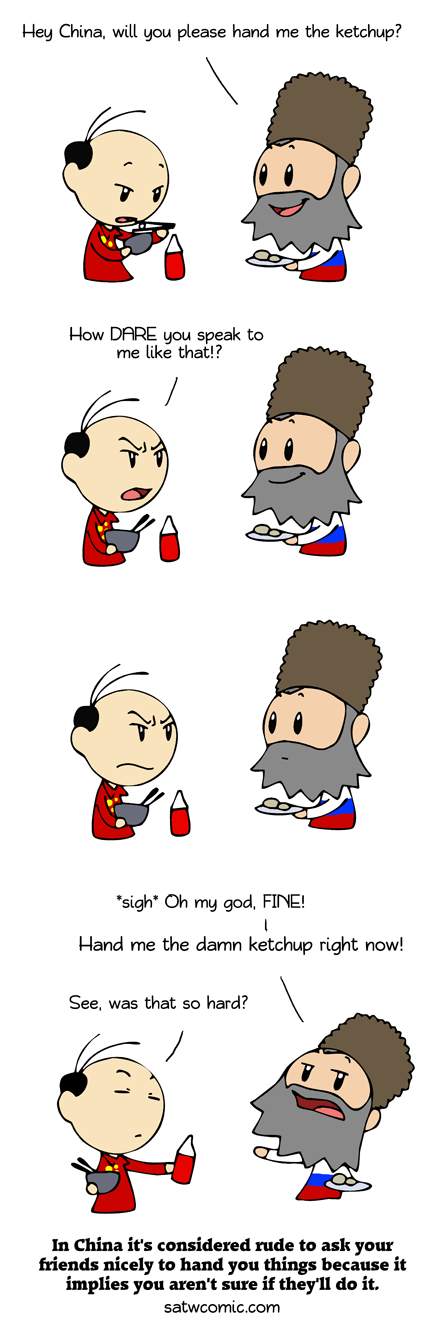
Since English doesn’t have codified politeness levels in grammatical structures (like Japanese does with eg verb endings, where tabe-ru is less polite than tabe-masu for the same verb meaning “eat”), we tend to make requests longer the more polite we’re being.
For example:
With close friends the first one is ok(ish) if your tone isn’t too commanding, but I’d normally stick to 2 through 4 (or 5). For some reason a “please” sounds overly polite whereas a “thanks” upon receiving the request doesn’t. I imagine this is different for other regions. I’m from the US northeast, but people from the south probably feel differently.
Using 私 in example 8 instead of オレ様 might look like a mistake but you have to understand that this is formal Japanese. In these sorts of situations everyone is armed to the teeth and one wrong word can lead to a massacre.
One time while attending a nomikai I drank before my senior and was beaten within an inch of my life. As they were about to finish me off with a rocket launcher my senpai swallowed a grenade on my behalf, excused himself and blew up outside the izakaya, this was fortunately enough for the senior to spare my life.
I am forever indebted to Suzuki-san for his noble sacrifice. Please use the above phrases well and you might survive and even thrive in Japan.
I’m writing this message from my hospital bed where I am waiting to have 50 chopsticks removed from my rectum (unrelated incident). Thank you again, Suzuki-san. I know you are watching over me from above in heaven.
One of my favorite random Japanese language coincidences is that one meaning of “yo” is the same in English and Japanese.
Let’s go, yo!
Ikou, yo!
Can’t forget the simplest form, at least in my language but pretty sure it works in English.
And that is just loudly declare the item you want:
SALT!