factorials are mostly encountered in combinatorics, which is problems like, how many ways are there to put 3 objects of different colors in a row? well, the first can be any of the 3, the second can be either of the other 2, and the last is whichever 1 is left, so 3×2×1=3!=6
so how many ways are there to put 0 objects in a row? well there’s 1, it’s this one:
Caught me by complete surprise too, when I first learned it. It’s undefined in most areas of math, I think, but in some it’s just following the convention, it seems:
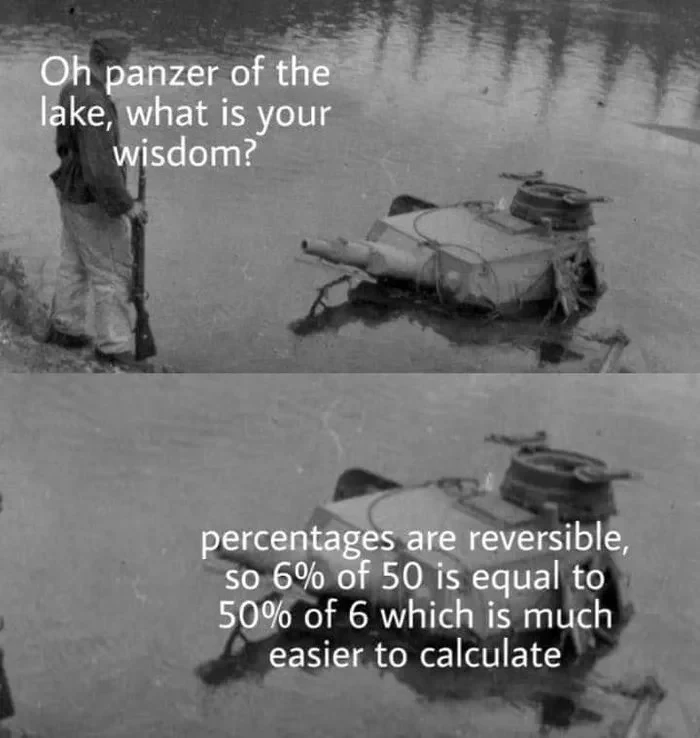
taking x% is just multiplying by x/100, and multiplication is commutative. x% of y is just y×x×1/100, which is the same as x×y×1/100
you can also ignore the % and divide by 100 at the end. for example, what’s 5% of 5? that might take a minute to work out. what’s 25/100? you instantly know it’s 1/4


Yo what
So 50% of 50 is the same as 50% of 50. Both equal 5
Your math is revolutionary.
More like 5 of these
5 sweet dreams, got it
Who am I to disagree?
Who am I to disagree
And the other half is 0! 5 0
0! is 0.
Edit. I remembered wrong. Keeping it like this as it is funnier that way.
factorials are mostly encountered in combinatorics, which is problems like, how many ways are there to put 3 objects of different colors in a row? well, the first can be any of the 3, the second can be either of the other 2, and the last is whichever 1 is left, so 3×2×1=3!=6
so how many ways are there to put 0 objects in a row? well there’s 1, it’s this one:
that’s why 0!=1
Wow, that was a really great explanation! Thanks! I could have needed this twenty years ago and maybe we wouldn’t have had this interaction.
Man math is hard
I love this so much
00 is 1.
Dammit, you’re right!
Caught me by complete surprise too, when I first learned it. It’s undefined in most areas of math, I think, but in some it’s just following the convention, it seems:
Depends on context.
real
deleted by creator
Multiplication is commutative.
50% of 6 == 50/100 x 6 == (50 x 6)/100 == 50 x 6/100 == 6% of 50.
Truetaking x% is just multiplying by x/100, and multiplication is commutative. x% of y is just y×x×1/100, which is the same as x×y×1/100
you can also ignore the % and divide by 100 at the end. for example, what’s 5% of 5? that might take a minute to work out. what’s 25/100? you instantly know it’s 1/4
Percentages can be expressed as multiplication and multiplication is commutative (the order doesn’t matter).