

1·
2 days ago25% at the risk of poverty/social exclusion is a terrible, terrible number.
It really is , and explains to me alot about what’s going on in that age group.

European 🇪🇺
25% at the risk of poverty/social exclusion is a terrible, terrible number.
It really is , and explains to me alot about what’s going on in that age group.
Erasmus is awesome.
This, or any sort of (students) exchange project really. Never did Erasmus myself but I did take a long summer course abroad and later a stage outside the country.
Enjoying the adventure, new cultures & freedom with little cash to spare is part of the experience somehow.
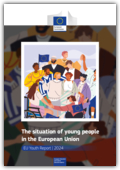
The Situation of Young People in the European Union (2024) – EU Youth Report Summary
The majority in this group seem to be doing quite ok, but health and social inclusion seems to be the important themes in this age group considering that:
Source: European Commission / EACEA, EU Youth Report 2024 & Le Chat AI
I found his trend study here,( German pdf) His sample was around 2K youngster , and his findings have ca. 2% error margin iiuc. He’s been publishing regularly since corona epidemic according to his website. What called my attention was especially this worrisome quote, which might explain what’s going on:
" The proportion of young people who say they need psychological support has also reached a new peak of 29 percent. Women, at 34 percent, and students, at 32 percent, are particularly affected by this psychological strain. Among young Germans without a job, 42 percent likewise rely on psychological support services."
I’m not sure how this trend compares to other ( European) countries, but I remember reading similar trends in several countries for years since the Corona epidemic. These issues require much more serious attention, studies and rapid & adequate solutions imo.
Add; just posted a comparative study here
good. It didn’t occur to me Moldova was still technically under CiS
The authorities say that this decision is a natural step in the context of the country’s European path and its goal of joining the European Union.
>janteloven ( Law of Jante)
I needed to look that up. Iiuc, that’s a bit of a Nordic protestant small town mentality which exists in other Northern European countries too in some way:
" is a code of conduct originating in fiction and now used colloquially to denote a social attitude of disapproval towards expressions of individuality and personal success. Coined by the Danish-Norwegian author Aksel Sandemose, it has also come to represent the egalitarian nature of Scandinavian countries." There are supposedly 10 rules of Jante.
So very interesting point to discuss further. There are pros and cons to this. Being humble is moslty a pro, but not seeing or acknowledging your strength or knowing what makes you different or unique can be a con, for example.
Well said.
I’d like to think of it as a selfown. But I have to admit that necessity usually is the strongest motivator for change. I’ve had a “green energy” contract for many years. Every year I try to find, proactively, new affordable an doable solutions for my energy usage & footprint. Right now considering a homebattery for example.
Europe is already feeling the consequences, with the benchmark Dutch TTF natural gas price surging around 70 per cent – putting March 2026 on course to be the highest monthly increase for European gas prices since September 2021.
People are " tired of being held hostage by fossil fuels"
Context: Per 2024 nearly 50% of EU electricity came from renewables according to Eurostat
Imo, the share of renewables in our energy production will certainly keep increasing, and our oil energy dependency will keep dropping.
There are rumours for a while now, that Kaja Kallas isn’t very" diplomatic" to this administration. There have been clashes before, and there were other officials like Christine Legarde, who couldn’t “stay polite”. I mean ofcourse European leaders get upset, how much shit can one take?
Also I’m sure that behind the doors and away from journalists things get heated. Hell, Denmark and allies were and are preparing against a US Greenland invasion, under the guise of a random Nato Exercise and Artic Protection op against Ruzzians that haven’t been spotted there in 10 years. The fact that Trump doubled down with his secondary tariffs on Europe and his Greenland invasion cq annexation, was only after Rutte whispererd something in his ears and the EU had announced a new military drill in Greenland and had opted the possibility of using it’s Trade bazooka. That says enough, just read between the… lines.
here an older link from nov 2025, “US Secretary of State declines meeting with Kaja Kallas”
Say No to Palantir in Europe (OP)
I get your sentiment. Palantir is just one of the many in the world providing algorithms & software to detect stuff. Governments use citizens data and tools to detect behavioural profiles and such.
On principle, I object to the use of citizens data. Although I understand that Governments say that they may want to use it to fight “terrorism & crimes” etc like in Germany. Imo, the problem isn’t necessarily people providing information it’s how it’s used like in your examples ICE in USA & Israel ( but also in China etc). Who is to say that changing providers will change the outcome, when he problem is the process or political anti human rights outcome?
For example here’s a longer list of samesuch providers:
What about companies like Intellexa, Candiru, Negg, Cy4gate, DSIRF, PARS, AEGIS (UK) , AggregateIQ (Canada)
Archimedes Group (Israel) , Black Cube (Israel & UK) , Booz Allen Hamilton (US)
Control Risks Group (UK) , Emerdata Limited (UK), Fusion GPS (US), Groupe GEOS (France) , Hakluyt & Company (UK)
Kroll Inc. (US) , NSO Group (Israel)
Oxford Analytica (UK), Palantir Technologies (US) , Pinkerton National Detective Agency (US) , Smith Brandon International, Inc.(US), Stratfor (US), etc.
Rutte cozies way too much up to Trumpler.
He does, that’s actually his job. The SG is basically USA’s lackey. So Rutte works for Trump. That’s the problem.
No problem.
Man, needed to read your comment a few times, because of my confusion with " US" and “us”. Also, the French title reads funny in English too.
But yeah, got it. Hope you can get your country back one day.
This former SG of Nato can say what our current SG Rutte cannot.
Well, that’s what the chatcontrol show is (really) about.
thank the good work of the few.
Some 200 + eu privacy watchdogs ( scientists, politicians & journalists) wrote an open critical letter in response to the first proposal. Others, like Patrick Breier cs. raised awareness.Then many citizens voiced their concerns to their Members of Parliament again and again. Thankfully, the EP listened and blocked the law, as it should be. It was thus the work of the many imo, and it was the voice of the people . Happy to see it worked out.
And indeed , I also don’t get the Danish PM, advocating in favour of chatcontrol was such a miss and out of touch with the wishes of the people.
It’s really weird how she talks about the housing crisis. I don’t see how this attitude can be constructive or how relevant her experience is in the military with showertokens and the shacks she was staying in. A house isn’t a shack except when camping or whatever.
Also the main problem was always that the Netherlands has a very high population density. Then combine this with strict environmental legislation and now the energy crises , causing all costs to rise
Another huge issue no-one is talking about, is how the area is being used. Iirc, 65% of the usable area is used for agriculture ONLY. Remember that it’s the top 3 largest foodmanufacturer/ exporter in the world.
And since foodprices have only gone up, and there is more famine due to wars and climate change, nobody would benefit from less food entering the markets. Also I think these farmers are very efficient and can make good money. So why should they change that too much?
I do hope innovative and durable solutions can be found for this issue in Europe.




Spot on imo. And we can start with trying to understand their situation & motives, and take it from ther. I’m seeing the effects with the youngsters and that triggered me to look it up.
#Add. Appreciate your confirmation and input.✌🏻