

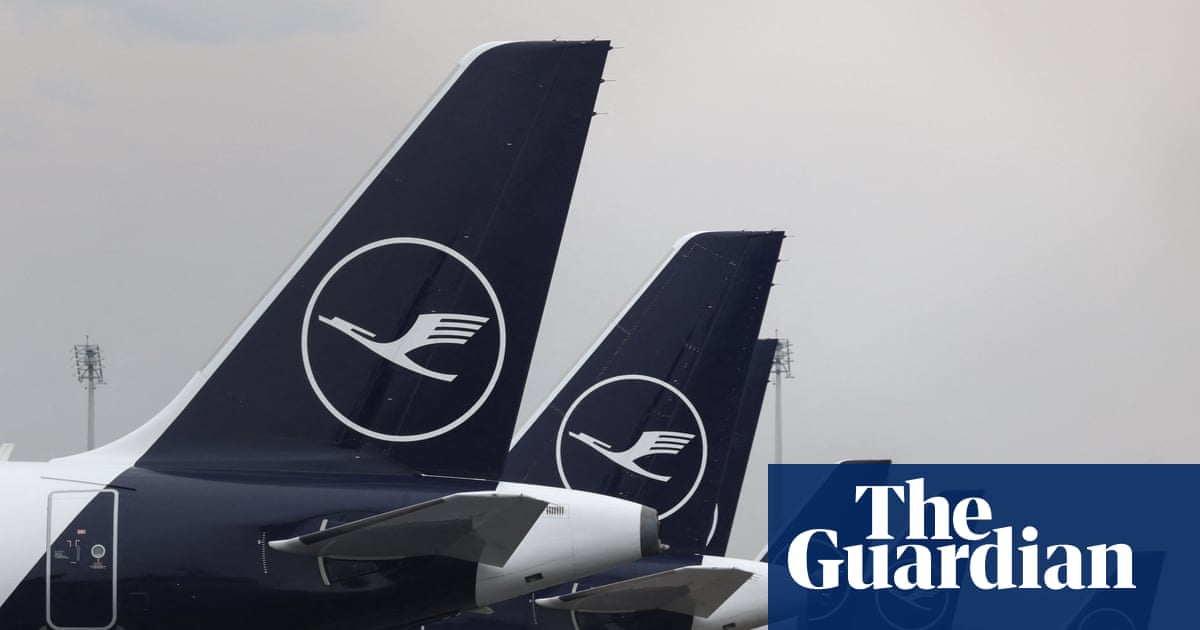
Europe’s smaller airports may not survive if jet fuel shortages triggered by the Middle East crisis lead to widespread route cancellations, the industry’s trade body has warned.
Although airlines insist there are currently no supply problems within the normal four- to six-week horizon, the US-Israel war on Iran and the effective closure of the strait of Hormuz have doubled the price of jet fuel, prompting some carriers to cancel flights.
The Airports Council of Europe said regional airports were the most exposed and faced an “existential threat” if airlines cut capacity and raised fares, as demand on their routes was generally more price-sensitive – demonstrated when Lufthansa axed 20,000 summer flights operated by its regional subsidiary, CityLine.
Yes, I really do think that changing the behaviour of those people who are producing 15% of global emissions will have an effect on global emissions.
Can you possibly post where to find the original image ? Too small to read anything other than some number.
And how this 15% is calculated ? What is included ? What is excluded ?
Are you sure that you are not targeting this 1% only because it is more simple to just say “is someone else fault” ?
Ask the World Economic Forum or the Stockholm Environment Institute:
https://www.weforum.org/stories/2024/05/climate-change-economic-impact-incomes/
(and if you are honest, it totally makes sense that rich people produce an overproportional amount of CO2. They have the money. They are flying. They are consuming more. They have bigger houses and all those fancy Saunas, Whirlpools and second homes. Why are you questioning that?)
Still make no sense if they don’t say what they consider in the data. CO2 is produced basically by every human activitiy (even breathing) so unless they specified what is included in the 15% the data are useless if not wrong entirely. Numbers can be manipulated to say a lots of things.
And they are the 1% of the total. I get that they might produce more CO2 of me, but for every rich person (how we define rich anyway ? Millionaire ? Billionaire ?) there are millions of people like me and you. And I am afraid that their bigger house, their bigger boats and so on are probably state of the art tech, mine and yours not so much…
For every private jet there are millions of cars used by normal people. There are an estimate of about 32k (registered) planes in the world that make about 100k flight a day. How many millions of cars are on the road daily ? (Hint: Rome alone has about 1.7 millions car on the road daily, make an educated guess on the total). And while a jet can produce more CO2 per person per km, they are offset by the sheer number of the cars which, while they produce about 1/4 of CO2 of the plane, are thousand of times more.