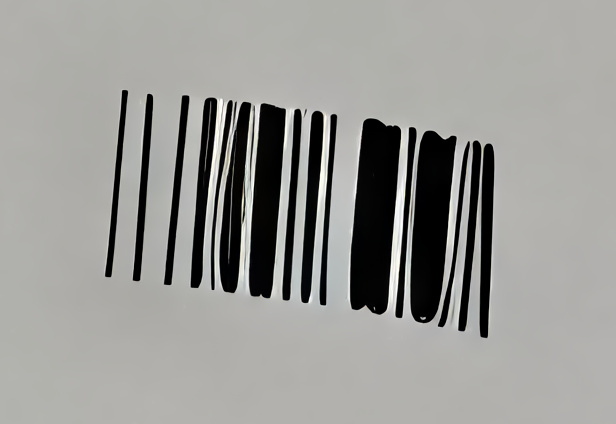
It’s the typical artifact created by AI when drawing multiple parallel lines, it’s immediately noticeable to me. This doesn’t look at all like image compression artifacts to me if that’s what you are saying.
Otherwise I would say this image is flawless, wouldn’t be able to tell.
Can you specifically describe what you are seeing then that stands out as an AI artifact? I am genuinely interested, not just try to challenge your statement. Here’s my observations and thoughts on it:
What I see is the JPEG compression blocks around the lines and characters where the chunk changes from a smooth color to a much noisier square; what looks to have once been much blockier aliased pixels forming the barcode lines that got scaled up and blurred, so now there are distinct vertical segments a within each line, as well as a noticeable gridding on the small characters (some of which might also be my viewer); and then possibly some sort of moire effect from the slightly angled barcode lines interacting with the grid of the pixels and/or JPEG compression chunk boundaries. As with many images on the internet, it looks like it has changed size and format in the past, and it’s possible that someone composting an image from different sources would end up with different artifacting in different places.
Given how small the details of the barcode are, I think they would have to come pretty much entirely from the VAE decoding itself, not from the typical generative AI denoising that we would typically associate with hallucinations, extra fingers, and all the other “classic” tells of older image generation models as well as the less-specific “wrongness” of some more recent ones. So it would AFAIK end up having to be a pretty specific artifact to the actual base model being used, and even then just doing a VAE encoding into the compressed, many-dimensional latent-space and immediately decoding would produce the same artifact, and that’s hardly an “AI” process on its own.
First, @nialv7@lemmy.world was right, the background by itself without the box has a synthid, I commented some screenshots below.
I also see those “ai artifacts” on the barcode, though I wasn’t as sure about it before seeing the synthid.
I can make out that the lines don’t run quite parallel but form these V and Λ shapes, closer together on one end and merging together.
Counting the left most blurry line as one, the 5th is leaning into the 4th line at the top for example. The compression is strong and the image doesn’t have enough resolution to make it out very clearly, but it still looks like an actual detail not a compression artifact to me. The lines are all a bit wonky, more than the noise could do.
Here’s a way more obvious example:
This has some other artifacts too that I don’t see in the post, but you can see the general wonkiness. And also how some lines have “bled” together, though this isn’t a great example of that.


It’s the typical artifact created by AI when drawing multiple parallel lines, it’s immediately noticeable to me. This doesn’t look at all like image compression artifacts to me if that’s what you are saying.
Otherwise I would say this image is flawless, wouldn’t be able to tell.
Can you specifically describe what you are seeing then that stands out as an AI artifact? I am genuinely interested, not just try to challenge your statement. Here’s my observations and thoughts on it:
What I see is the JPEG compression blocks around the lines and characters where the chunk changes from a smooth color to a much noisier square; what looks to have once been much blockier aliased pixels forming the barcode lines that got scaled up and blurred, so now there are distinct vertical segments a within each line, as well as a noticeable gridding on the small characters (some of which might also be my viewer); and then possibly some sort of moire effect from the slightly angled barcode lines interacting with the grid of the pixels and/or JPEG compression chunk boundaries. As with many images on the internet, it looks like it has changed size and format in the past, and it’s possible that someone composting an image from different sources would end up with different artifacting in different places.
Given how small the details of the barcode are, I think they would have to come pretty much entirely from the VAE decoding itself, not from the typical generative AI denoising that we would typically associate with hallucinations, extra fingers, and all the other “classic” tells of older image generation models as well as the less-specific “wrongness” of some more recent ones. So it would AFAIK end up having to be a pretty specific artifact to the actual base model being used, and even then just doing a VAE encoding into the compressed, many-dimensional latent-space and immediately decoding would produce the same artifact, and that’s hardly an “AI” process on its own.
First, @nialv7@lemmy.world was right, the background by itself without the box has a synthid, I commented some screenshots below.
I also see those “ai artifacts” on the barcode, though I wasn’t as sure about it before seeing the synthid.
I can make out that the lines don’t run quite parallel but form these V and Λ shapes, closer together on one end and merging together.
Counting the left most blurry line as one, the 5th is leaning into the 4th line at the top for example. The compression is strong and the image doesn’t have enough resolution to make it out very clearly, but it still looks like an actual detail not a compression artifact to me. The lines are all a bit wonky, more than the noise could do.
Here’s a way more obvious example:
This has some other artifacts too that I don’t see in the post, but you can see the general wonkiness. And also how some lines have “bled” together, though this isn’t a great example of that.