it’s very often not useful. Like, what’s 6% of 80? See. Still hard.
Also, with the 6% of 50 example it’s easy without using this trick.
What’s 6% of 100? 6, right? So cut 100 in half to get to 50, and cut the 6 in half to get the 3. Cut the 50 in half again and cut the 3 in half again, and you’ll also know that 6% of 25 is 1.5.
Which also lets you know that 6% of 75 is 4.5. the 3 from the 50, plus the 1.5 from the 25. or just know to split the difference between the 3 at 50 and the 6 at 100.
A lot of math is just tricks for a thinking process.
6% of 80.
1% of 80 is 0.8
0.86 is (86)/10
Which is 48/10 = 4.8
80% of 6.
I’d probably think of it as (4/5)*6 = 24/5
Which is 20/5 + 4/5 = 4 + 4/5 = 4.8
Both are easy if you know how to visualise it. The benefit of knowing you can “reverse” it is that you can choose which method is easier for you to visualise. Which is incredibly useful for a lot of people


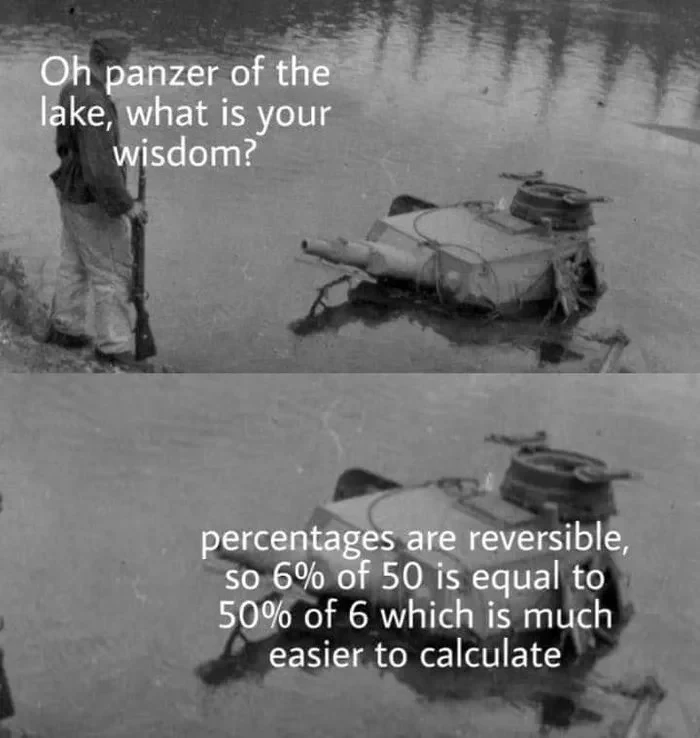
it’s very often not useful. Like, what’s 6% of 80? See. Still hard.
Also, with the 6% of 50 example it’s easy without using this trick.
What’s 6% of 100? 6, right? So cut 100 in half to get to 50, and cut the 6 in half to get the 3. Cut the 50 in half again and cut the 3 in half again, and you’ll also know that 6% of 25 is 1.5.
Which also lets you know that 6% of 75 is 4.5. the 3 from the 50, plus the 1.5 from the 25. or just know to split the difference between the 3 at 50 and the 6 at 100.
A lot of math is just tricks for a thinking process.
6% of 80. 1% of 80 is 0.8 0.86 is (86)/10 Which is 48/10 = 4.8
80% of 6. I’d probably think of it as (4/5)*6 = 24/5 Which is 20/5 + 4/5 = 4 + 4/5 = 4.8
Both are easy if you know how to visualise it. The benefit of knowing you can “reverse” it is that you can choose which method is easier for you to visualise. Which is incredibly useful for a lot of people
Good luck explaining your supreme methodology to anyone that isn’t a geek.
It’s stupid simple… If you know 6% of one hundred is 6, then you should know 6% of 50 is 3. You just cut each number in half.